Post page

The Sh’ma

Therefore it is our duty to thank You, and to praise, glorify, bless, sanctify and give praise and thanks to Your name. Happy are we, how good is our portion, how lovely our fate, how beautiful our heritage. Happy are we who, early and late, evening and morning say twice each day –

שמע ישראל ײ אלהינו ײ אחד

Listen Israel: the L-rd is our G-d, the L-rd is One.
Blessed be the name of His glorious kingdom for ever and all time.

Love the L-rd your G-d with all your heart, with all your soul, and with all your might. These words which I command you today shall be on your heart. Teach them repeatedly to your children, speaking of them when you sit at home and when you travel on the way, when you lie down and when you rise. Bind them as a sign on your hand, and they shall be an emblem between your eyes. Write them on the doorposts of your house and gates.

During periods of persecution the joyful lead-in to the Sh’ma serves as a bold refutation of our perilous conditions. Our freedom to express our faith through observing the Shabbat, reciting the Sh’ma, and studying Torah is a perennial target of our oppressors; their constant goal is to separate us from the core of our faith in the One True G-d. Yet whether we live our days harassed or welcomed, we must cling to these precious foundation stones with heartfelt delight and gratitude.

“Listen Isra’el: the L-rd is our G-d, the L-rd is One.” The Sh’ma, known to the youngest child, and often the last words spoken prior to death, is the timeless affirmation of our faith.

“Blessed be the name of His glorious kingdom for ever and all time.” This is spoken quietly, practically inaudibly – with the only exception during Yom Kippur when we are released to declare these words in our loudest voice. There are various teachings for this practice, all of which provide deep insights to our ancient culture.

Immediately following the Sh’ma, the v’Ahavtah begins with a mandate to love HaShem completely. The Ḥazal teaches that Avraham loved HaShem with all his heart; that Yitzḥak loved HaShem more than his own “נפש“ (soul), as demonstrated in the Akdeidah; and that Ya’akov loved HaShem “מאדך,” a word which is difficult to translate. Frequently translated into English as might, strength, or resources – the concept is “everything, and more; and still more; and then some.”

The v’Ahavtah extends the Sh’ma across generations; we are commanded to teach our children “repeatedly … when you sit at home … when you travel on the way … when you lie down … when you rise.” Surpassing mere transfer of information – this is an imperative to live so that our children grow to love HaShem.

The v’Ahavtah finishes by drawing our attention to “a sign on your hand … an emblem between your eyes … [written on] the doorposts of your house and gates.” The mitzvot of laying t’fillin and of hanging mezuzot are based on these commandments. We bring our daily lives into alignment with HaShem through repeated physical acts of obedience, and it is through His great compassion for us that He bestows us with an abundance of mitzvot.

The prayers which follow the v’Ahavtah are laser-focused on Hashem: He is our Eternal King, beyond infinity yet within every individual. We sanctify His Name and also those through whom His Name is sanctified – a reminder to guard against taking G-d’s name לשוא (casually), plus quiet homage to those who have and will defend His Name through Kiddush HaShem.

His Salvation gives us assurance that we will one day see Him known by all nations. We eagerly await the day when He redeems us from exile. We yearn to see the rebuilt Holy Temple and to once again proclaim Him to all creation as the One True G-d. We imagine preparing the daily sacrifices in the rebuilt Holy Temple – we now are ready to study those very offerings.

Recap:
We’ve learned that the Mah Tovu prayer, which we sing individually as we enter the synagogue, exhorts us to leave all our personal joys and sorrows behind so we may worship without distraction.

The Adon Olam pulls us into a greater awareness of Hashem as the G-d of all the vastness of infinite creation – yet also as our personal ever-present G-D.

Yigdal then directs our attention to Israel’s unique connection with Hashem. He is the G-d of Israel; revealing Himself to us in ways the nations do not yet see. The familiar rhythms of the Birkat HaShaḥar reinforce our unique relationship with HaShem as interconnected individuals within the Nation.

The Akeidah anchors us to the very beginning of Judaism – the faith of our father Avraham.

The Sh’ma and the prayers completing this section of services summarize Israel’s declaration to the nations of the One True G-d and Israel’s hope of redemption – an anchor during our darkest days of persecution.
Birkat HaShaḥar

The Birkat HaShaḥar (morning blessings) is our springboard into each day. It is recited upon waking, but over time it has also become part of the daily Shaḥrit service. The blessings connect us to Israel, to HaShem, and to the nations, spanning the immediate to the infinite and revealing how insignificant – and irreplaceable – we are in G-d’s amazing creation plan. Each blessing begins with the same phrase, anchoring our thoughts and focusing our attention as we enter into the familiar cadence,
“Blessed are You, Hashem, our G-d, King of the universe . . .

“Who gives the heart understanding to distinguish between day and night.”
As with so many of our communal prayers, our challenge is to rise above tedious sight-reading to being captivated by their fullness. We notice sunrise; we recognize good; we perceive eternal truths; we detect the spark of divinity in one another.

“Who has not made me a heathen.
“Who has not made me a slave.
“Who has not made me a woman. / Who has made me according to His will.”
We are grateful for what we aren’t; we are also grateful for what we are. “ . . . We are the clay, and You are our potter: and we are all the work of Your hand” (Yesha’yahu 64:7(8)). No matter our role, we should always defer to others; extending both honor and compassion to everyone we meet.

“Who gives sight to the blind.”
This literally means “who opens our eyes.” This describes physical sight, but we can also see this as the capacity to view everything from Hashem’s greater perspective.

“Who clothes the naked.”
Clothing provides us basic protection from the elements, but clothing is much more than that. When we select our wardrobe for the day we are essentially putting on our daily “uniform” which communicates our identity to those we meet throughout the day. The care with which we dress, whether provocative or modest, is a direct reflection of our call to be a separate people, a light to the nations.

“Who sets captives free.”
At its simplest, this describes regaining control over our physical bodies as we awaken each day (we spend our sleeping hours in a form of paralysis which prevents us from acting out dreams). Deeper meanings include freedom from any form of restricted movement, from any inability to express ourselves.

“Who raises those bowed down.”
Yes, we arise and stand up as we ready for each day – this also beautifully depicts how HaShem redeems lives.

“Who spreads out the earth above the waters.”
Bam! Paradigm shift! Pulled abruptly away from our line of thought, we are called to “know before whom we stand” – HaShem, G-d of all creation, beyond time and space, the indescribable Ein Sof.

“Who has provided me with all I need.”
After the previous reality check, and keenly aware that HaShem is the source of all creation, we resist dwelling on our perceived unmet needs. Instead, we are deliberate in appreciating all that HaShem has already provided to us, no matter how abundant or meager, taking nothing for granted.

“Who makes firm the steps of man.”
HaShem plants within each of us the desire to follow Him, and firms our steps based on the choices we actually make. This is a poignant reminder to live intelligently disciplined lives, measuring every decision with the knowledge that HaShem will firm our trajectory based on what we pursue.

“Who girds Israel with strength.
“Who crowns Israel with glory.”
As we make our choices throughout the day, we rest in HaShem’s powerful love for Israel. This reassures us that as we choose to follow Torah with Israel our steps will be aligned with HaShem’s greater purpose, and we will bring merit to the Nation.

“Who gives strength to the weary.”
We are all creatures of limited strength, no matter how mighty or frail. Our limitations require that we prioritize our activities, which in turn show those around us our true relationship with HaShem.

“Blessed are You, Lord our God, King of the Universe, who removes sleep from my eyes and slumber from my eyelids. And may it be Your will, Lord our G-d, and the G-d of our forefathers, that You accustom us to [study] Your Torah and make us attached to Your commandments. Lead us not into error, transgression, iniquity, temptation or disgrace. Do not let the evil instinct dominate us. Keep us far from a bad man and a bad companion. Help us attach ourselves to the good instinct and to good deeds and bend our instincts to be subservient to You. Grant us, this day and every day grace, loving-kindness, and compassion in Your eyes and in the eyes of all who see us, and bestow loving-kindness upon us. Blessed are You, Lord, who bestows loving-kindness on His people Israel.”

The finale is a montage of parting thoughts and supplications toward being better people by each day’s end than when we awoke. When we read “lead us not into error . . . ” we cannot help but hear those same words echoed in Yeshua’s “Lord’s Prayer,” reminding us that G-d is the same yesterday, today, and forever. We are now ready to face the day in pursuit our raison d’être – choosing of our own free will to love HaShem through our thoughts, words, and actions.

Eshet Ḥayil

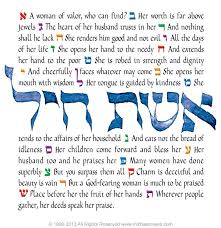
Mishlei (Proverbs) 31 is a fixture of our Erev Shabbat services. Placed in the midst of the songs and prayers of the evening, Eishet Ḥayil is a beautiful interlude during which men sing to their wives, declaring her before all present as precious, industrious, respected, virtuous, righteous, and praiseworthy.

To truly understand all the implications of this glowing tribute, however, we need to “start at the beginning.” You see, the Eishet Ḥayil with which we are so familiar starts in verse 10! Here are the first 9 verses:

“The words of King L’mu’el, the prophecy with which his mother disciplined him:
“No, my son! No, son of my womb! No, son of my vows!
“Don’t give your strength to women or your ways to that which destroys kings.
“It is not for kings, L’mu’el, not for kings to drink wine;
“It is not for rulers to ask, ‘Where can I find strong liquor?’
“For they may drink, then forget what has been decreed,
and pervert the justice due to the poor.
“Give strong liquor to one who is perishing, wine to the deeply depressed;
Let him drink, forget his poverty and cease to remember his troubles.
“Speak up for those who can’t speak for themselves,
for the rights of all who need an advocate.
“Speak up, judge righteously, defend the cause of the poor and the needy.”

Mishlei 31:1-9 CJB


Our initial reaction is, “why does this beautiful mishlei start so strangely?” The glaring contrast gets our attention, pulling us to further examine the context so crucial to our understanding.

Our Sages of blessed memory explain that these verses are Bat-Sheva haMalḥa’s (Queen Bathsheba’s) warning to her son Shlomo haMeleḥ (King Solomon) in which she admonishes him to live the “intelligently disciplined life” which he so aptly describes in Mishlei (Proverbs)1:3. The familiar prose of Eishet Ḥayil then follows; but the words are not Shlomo’s – they are the eulogy which Avraham Avinu composed when his wife Sarah died. Shlomo includes it here in response to his mother Bat-Sheva as a tribute to her desire for him to find an exemplary wife.

At first glance it certainly seems a bit odd that men sing an ancient eulogy to their wives each week. We’ve all heard the entreaty to appreciate our loved ones while they are still alive, but isn’t this just a little – for lack of a better word – creepy? It certainly doesn’t seem very romantic!

Consider this. Because it is a eulogy, Eishet Ḥayil brings a timeless perspective of what otherwise appears to be a dauntingly exemplary life. It considers a woman’s life in its entirety, conferring honor upon her for all her accomplishments, both past and future. It sees the best in her, because, in the long run, that’s her legacy.

It serves as a reminder to her husband that, beyond her roles of wife and mother within the household, she is a vital member of the community; and her good reputation enhances his good name. To her husband, it is a clarion call to self-examination – while opportunity still exists, today, in this moment, how can he encourage her toward her greatest potential?

Tomorrow is promised to no one. Just as every man is reminded of his own mortality each time he puts on his kittle, he is also reminded of his wife’s mortality each time he sings Eishet Ḥayil to her. No matter his oratory skills, Eishet Ḥayil provides a unique venue for a man to speak love in a way that resonates with his wife. Most importantly, it gives him the words which his heart yearns to say so he needn’t one day have regrets for having left it all unspoken.

Adon Olam

Adon Olam
L-rd of the Universe,
who reigned before the birth of any thing –
When by His will all things were made
then was His name proclaimed King.
And when all things shall cease to be
He alone will reign in awe.
He was, He is, and He shall be
glorious for evermore.
He is One, there is none else,
alone, unique, beyond compare;
Without beginning, without end,
His might, His rule are everywhere.
He is unfathomable, incomparable,
unchanging and unexchangeable;
He cannot be aggregated nor dispersed;
He is great of power and strength.

He is my G-d; my Redeemer lives.
He is the Rock on whom I rely –
My banner and my safe retreat,
my cup, my portion when I cry.
He is a healer and a cure;
He is all-seeing and a support.

Into His hand my soul I place,
when I awake and when I sleep.
The L-rd is with me, I shall not fear;
body and soul from harm will He keep.
In His Sanctuary will my soul rejoice;
may he send our Messiah speedily.
Then shall we sing in the Holy Temple,
Amein, Amein to the awesome Name.

Note: Additional verses from the Sephardic version are noted in blue.

The Adon Olam prayer officially begins the synagogue service. Although it is a popular practice in many synagogues to sing this piyyut at the end of services, traditional Siddurim also include it as the first congregational prayer each morning.

We’ve learned that the focus of the Mah Tovu prayer, which we sing individually as we enter the synagogue, is to exhort us to leave all our personal joys and sorrows behind so we may worship without distraction. We then sing the Adon Olam together to begin our Shaḥrit service.

The words of the Adon Olam pull us into a greater awareness of Hashem. He is the ineffable G-d; the Ein Sof. The Adon Olam brings specific attributes to mind so that we can relate to Hashem the infinite – as best we can.

Hashem is King. His kingship is not dependent upon having a nation to rule; He was King before creation and He will remain King after creation has passed away. Unlike earthly kings, Hashem’s sovereignty is derived from no one but Him. Creation does not make Him King; creation proclaims Him King.

Hashem is Creator. The purpose of creation is for man, of his own free will, to choose Hashem. From the smallest particle to the greatest galaxy, all creation points to Hashem as Creator; all creation beckons us to seek Him.

Hashem is Eternal. We shift away from the overwhelming design of His creation to contemplate the mind-blowing vastness of Him. Hashem can be contained in neither time nor space; His existence is even beyond eternity. We are confronted with the challenge to envision the indescribable and to understand the unfathomable.

Hashem is Personal. After barely tasting the infinite we are suddenly launched into an accounting of all the ways in which Hashem personally relates to each of us. He is my G-d, my redeemer, my rock, my banner, my protector, my deliverer, my healer, my provider.

Each description is worthy of a paragraph yet this list is far from exhaustive. My G-d, who is beyond infinity, is intimately involved in my every day. Every part of my existence is fully infused with Hashem’s presence.

In the Sephardic closing lines we join in eager anticipation of the rebuilt Holy Temple and the days of Machiaḥ, capturing beautifully the vision penned by Malaḥi, “There we will serve You with reverence as in the days of old and as in former years.”

Beyond Recognition

We’ve all watched movies about Machiaḥ. We’ve all seen paintings depicting images of Machiaḥ. The actors and images seldom look Jewish and are always classically handsome. It’s all so subtle and pervasive that we don’t realize how these images affect the way we picture Yeshua – and how we relate to Him.

Think of the portrayals of Yeshua by Jeffrey Hunter (King of Kings, 1961), Jim Caviezel (The Passion of the Christ, 2004), and Diogo Morgado (Son of G-d, 2014). They are handsome; they have screen presence. Greco-Roman influences on Western culture pre-condition us to see Him as authoritative and virtuous, practically floating a few inches off the ground in divine righteousness.

We trust pretty people, yet scripture actually cautions us about those who are charming and beautiful. In 2 Corinthians 11:14 (CJB) we are warned, “. . . the Adversary himself masquerades as an angel of light.” Beauty isn’t truth, no matter what John Keats penned in “Ode to a Grecian Urn.”

Saul, our first king, was described as tall and handsome. This is a giant red flag from a Judaic perspective, a signal that things won’t turn out well. When Sh’mu’el HaNavi considers the sons of Yishai, HaShem reminds him, “Don’t pay attention to how he looks or how tall he is . . . Adonai doesn’t see the way humans see – humans look at the outward appearance, but Adonai looks at the heart.” 1 Sh’mu’el 16:7 (CJB)

According to Scripture prophecies, Yeshua was not attractive. In Yesha’yahu 53:2 we read, “He was not well-formed or especially handsome; we saw him, but his appearance did not attract us.” (CJB) Yeshua’s appearance was so ordinary and commonplace that Judas had to identify him for arrest.

Okay, so here’s an exercise. Instead of the above-referenced actors, imagine Yeshua being portrayed by Jewish celebrities such as Woody Allen, or Rick Moranis, or Marty Feldman, or even Rodney Dangerfield. For just a few minutes, “hear” Jackie Mason’s gravelly voice speaking the Sermon on the Mount. It’s disconcerting but pivotal.

We truly see Yeshua only after we smash our images of Him. When we know Yeshua by His teachings, His miracles, His life, our relationship with Him transcends to the amazing.