Post page

The Akeidah

The Akeidah is our first Torah reading during Shaḥrit services but the second Torah reading of the morning.  The Blessings Over the Torah, said at home during our early morning prayers, officially begins our daily Torah study and also sets the expectation that we will continue in further Torah study throughout the day.  Since it is essential to directly connect an activity with the blessing for that activity, we immediately follow The Blessings Over the Torah with a Torah reading (the Birkat HaCohanim) followed by commentaries from both Mishna and Gemara.

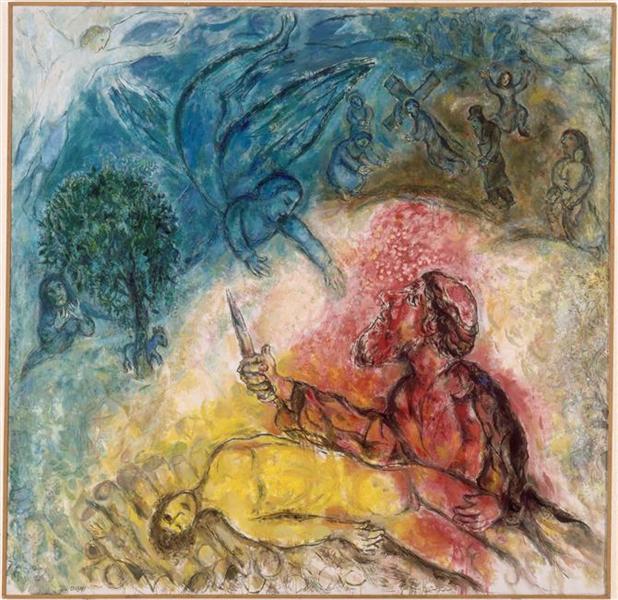
The Akeidah, also known as the Binding of Yitz’ḥak, hinged on Yitz’ḥak’s willingness to allow his elderly father to sacrifice him on the altar built on Har HaBayit (Mount Moriah).  Yitz’ḥak was a man in his 30’s at that time yet all indications are that he freely gave his cooperation.  He understood and embraced the singular purpose given him; Yitz’ḥak was ready to die.

The Biblical account of the Akeidah does not focus on Yitz’ḥak but on his father.  Why is our attention drawn to Avraham?  Yitz’ḥak was the heroic one – right?  Yes, but Avraham’s task was vastly different from Yitz’ḥak’s – and far more difficult to endure.
Marc Chagall

HaShem commanded Avraham to kill his son.  There may be merit in being willing to die, to sacrifice your life for others – but how do you embrace the thought of sacrificing someone you love, of killing your only child?  When HaShem called Avraham to take “your son, your only son, Yitz’ḥak, whom you love . . .” He was drawing Avraham into an agonizing act of faith, an act which could only be misunderstood and condemned by everyone he knew.

Through His harsh directive HaShem allowed Avraham a glimpse of His own agony, of the immense price He paid for eternal Israel.  Avraham was convinced his son was about to die; Mashiaḥ Ben Yosef actually dies.  To truly engage with the Akeidah is to be emotionally exhausted.

Our response, entitled “Accepting the Sovereignty of Heaven,” dates from a period of persecution during which Shabbat observance and Torah study were forbidden.  It is poignant to realize that our challenge to be consistently observant in all we do, both public and private, was written at a time when we were forced to practice our faith in secret; at a time when many instead chose Kiddush HaShem (martyrdom).  Faced with the enormity of this challenge of faith, we pour out our hearts:

“What are we?  What are our lives?

What is our loving-kindness?  What is our righteousness?

What is our salvation?  What is our strength?

What is our might?  What shall we say before You,

L-rd our G-d and G-d of our ancestors?

Are not all the mighty like nothing before You,

The men of renown as if they had never been,

The wise as if they know nothing,

And the understanding as if they lack intelligence?

For their many works are in vain,

And the days of their lives like a fleeting breath before You.

The pre-eminence of man over the animals is nothing,

For all is but a fleeting breath.

“Yet we are Your people, the children of Your covenant,

the children of Avraham, Your beloved, . . .”

Notice how we plummet to abject insignificance and then abruptly soar to mighty purpose.  These sudden shifts should begin to feel familiar as we move from the Mah Tovu to the Adon Olam, Yidgal, Birkat HaShaḥar and now the Akeidah. 

As our perspective repeatedly swings between the miniscule and the infinite, from the individual to the Nation to the Ein Sof, we sense the rhythm of worship.  To those new to Judaism this may feel more jolting than rhythmic.  Yet over the months and years as we incorporate these prayers into our daily lives these seemingly incongruous perspectives somehow reconcile; we continue next with the preliminary prayers for the Sh’ma.
Seder HaKorbanot Part One

The Tamid Offering

“At that time I will bring you home, and at that time I will gather you, for I will give you renown and praise among all the peoples of the earth when I bring back your exiles before your eyes, says the L-rd.”  With these words from Tz’fanyah 3 (Zephaniah) our focus shifts to the Seder HaKorbanot (the order of the offerings), a thumbnail sketch of the Holy Temple offerings.

The importance of the Temple offerings is highlighted by an intriguing detour; rather than launching immediately into the description of the actual offerings, we first study the preparations which lead up to them.  Reading excerpts from Yeḥezk’el (Ezekiel) and Vayikra (Leviticus), we become immersed in the sights and sounds of Temple life.

We first see the bronze basin and bronze laver.  The Kohanim (priests) wash their hands and feet when they enter the Mikdash (Tent of Meeting) and again before approaching the altar, explained simply with, “so they will not die.”  There are no minor or perfunctory duties in the Temple; each one is to be approached respectfully and diligently.

We then witness the meticulous procedure for taking the ashes from the altar.  Notice that this seemingly menial series of tasks is described as “the law of the burnt offering” and includes specific instructions for the offerings, the ashes, the fire – even what clothes are to be worn at which times.

Now, ready to consider the details of the offerings, we pause momentarily to lift our hearts and eyes heavenward,  “May it be Your will, L-rd our G-d and G-d of our ancestors, that You have compassion on us and pardon us all our sins, grant atonement for all our iniquities and forgive all our transgressions.  May You rebuild the Temple swiftly in our days so that we may offer You the continual offering that it may atone for us as You have prescribed for us in Your Torah through Moses Your servant, from the mouthpiece of Your glory, as it is said: The L-rd said to Moses . . . “

Excerpts follow from BMidbar 28 (Numbers) and Vayikra 1 (Leviticus) which provide the description of the Daily Sacrifice – the Tamid offering – directly from the Torah.  Notice that Moshe is to command the Israelites to “Be careful to offer to Me at the appointed time My food-offering consumed by fire, as an aroma pleasing to Me.”  Again we see an admonition for scrupulous attention to detail.  (Imagine presenting a gift to a world leader, or to a cherished loved one – how much more fastidious we should be when presenting an offering to HaShem, L-rd of all creation!)

The offering components are described and then a seemingly minor yet immensely significant phrase precedes the recap: “This is the regular burnt-offering instituted at Mount Sinai as a pleasing aroma, a fire-offering made to the L-rd.”  Our national memory awakens; despite our centuries without the Beit HaMikdash (Holy Temple) we remember the magnificence of the days of old – then, as our vision slowly fades, with a mixture of sadness and hope we conclude, “May it be Your will, L-rd our G-d and G-d of our ancestors, that this recitation be considered accepted and favored before You as if we had offered the daily sacrifice at its appointed time and place, according to its laws.”

Comprised of two yearling lambs, together with their designated meal and wine offerings (one lamb at sunrise, the other at dusk), the Tamid is the first and last offering every day.  Preparations for the Tamid offerings begin long before sunrise; the concluding activities last long after sundown.  The yearling lambs have to be available and inspected.  The grain, oil, and wine must be ready.  The duty priests must be present, and they must know precisely how to perform each part of the sacrifice.  All this took place twice daily, week after week, year after year, century upon century.

In Judaic thought the most frequent activities are often imbued with the greatest holiness.  We are taught that it is better to give one groschen for tzedakah (charity) one hundred times, rather than one hundred groschen at one time, as the more frequent giving builds a habitual awareness of our opportunities for tzedakah.  They also teach that Shabbat, every Shabbat, is the holiest day of the year.

The Tamid is not only the foundation of the Holy Temple offerings; it is our first lesson in understanding how to view things which at first glance appear to be commonplace.  When we see the breathtaking beauty of routine holiness, measuring every moment, every choice, against His Torah, we joyously endeavor to perfect every mitzvah – even though another opportunity is already on the horizon.  Indeed, this is living a life pleasing to HaShem.

Seder HaKorbanot (Introduction)

As we conclude our Pesaḥ Seder each year we join together with the Jewish Nation, declaring, “Next Year in Jerusalem!”  In that moment we envision ourselves in the midst of this festive annual pilgrimage to our rebuilt Holy Temple in Jerusalem, joyously sharing in the Korban Pesaḥ (roasted lamb or goat) with family, friends, and neighbors.  

Pesaḥ is a familiar picture of Temple life.  The Pesaḥ sacrifice, as described in Vayikra (Leviticus) 23, is offered by an individual on behalf of those who will join him in his household’s Pesaḥ Seder.  It is in B’Midbar (Numbers) 29, though, where we learn of the national offerings – it is these offerings which are commemorated in traditional Siddurim.  

Our connection with HaShem spans our lives both individually and nationally.  Our days are replete with opportunities for individually connecting with HaShem through both prayer and mitzvot.  As we gather in our local synagogues, though, our focus is on connecting with HaShem nationally; we pray as a nation, we commemorate the national offerings.  

Synagogues originated as “Bayit T’fillah” during the Babylonian Exile.  Without the Holy Temple for the first time in our nation’s history, our leaders, known as “the Men of the Great Assembly,” diligently studied Torah as we held onto HaShem’s promise to restore us to the Land.  In addition to the Bayit Din (judicial system using Torah as our “constitution”) and Bayit Midrash (schools for Torah study), they developed Bayit T’fillah (house(s) of prayer) in order to commemorate the Temple sacrificial services.   Their goal was two-fold:  to use the Torah as the foundational structure of our judiciary and education systems, and to preserve the details of the Temple sacrifices so we would be ready to resume them when our exile ended.

This three-fold structure sustained us during the exile and continued to provide a strong network of community after HaShem restored us to the Land.  As we gathered daily in our local Bayit T’fillah to commemorate the Temple sacrifices Jerusalem didn’t seem so far away.  Later known by the Greek word “synagogue,” they continued to provide structure throughout the nation, combatting the allure of idolatry in our communities, including even those far from Jerusalem.  

The Amida prayer is the pinnacle of each synagogue service just as the sacrifice is the pinnacle of each Holy Temple service.  Each Temple sacrifice (Shaḥrit, Musaf, Minḥa, Ma’ariv, etc.) has its own version of the Amida, the “standing prayer” which was voiced by those in attendance during the Temple sacrifice.  The design of each service is for us to ascend to and then descend from the height of the Amida. 

Consider for a moment the components of the sacrificial system:  meat, grain, wine, and incense.  Note how each component gradually guides our attention away from our ordinary daily existence, ushering our awareness toward the hidden eternal. 

Meat is the most “close to home” in that the sacrificial animals are physically similar to us – they have bodies, legs, faces; we can look into their eyes.  Grain and oil are somewhat removed from us – they are plant-based and also have less texture than meat.  Wine is poured on the altar and has even less texture than grain.  Each component is a bit less involved with the corporeal, providing opportunity to be more aware of the eternal.

Incense offerings, which happen twice daily as the menorah is cleaned every morning and lit every evening, take place solely within the Heiḥol (the front room of the Temple building).  Only the officiating Kohen sees the incense offering.  As the “hidden” offering, incense reminds us of the intimate connection we have with HaShem as His chosen people.

Traditional Siddurim include a brief study of the national sacrifices during the daily Shaḥrit service – mere gleanings of the exhaustive descriptions in Talmud – so each generation can commemorate and anticipate the national sacrifices, remaining constantly ready for the rebuilt Holy Temple.  

Ester

The book of Ester is a small book, a mere ten chapters.  Most of us can relate the main events by heart.  We imagine ourselves as Queen Ester, convinced we share her courage and faith.

Do we?  In our fast food immediate gratification mindset, we can quickly lose our resolve.  We get anxious when we wait a year, a month, or even a week for Hashem’s response.  The timeline for the book of Ester spans eleven years!  

The book opens with Aḥashverosh holding a six-month feast followed by a seven-day banquet.  Vashti refuses to appear when beckoned, and the search for a new queen begins.  

The search takes four years.  Each girl undergoes a one-year preparation period prior to being presented to King Aḥashverosh; six months treatment with oil of myrrh, followed by six months with perfumes and other cosmetics.  Ester is brought to King Aḥashverosh at the end of this period and is crowned queen.  

Haman’s power and influence over King Aḥashverosh – along with his hatred toward Mordeḥai and the Jewish people – intensifies during the next five years.  Haman and the king’s servants spend the entire tenth year of the timeline casting lots – “throwing pur” – and Adar 13 is selected for the date of destruction.  Haman convinces King Aḥashverosh to issue the decree – and the eleventh year begins.

The first month is packed with events.  After her three day fast, Ester approaches King Aḥashverosh and he & Haman attend the two feasts she hosts for them.  Ester exposes Haman’s plot and he is killed on the very gallows he had built for hanging Ester’s Uncle Mordeḥai.

Ester’s task is not yet complete; a month later she approaches King Aḥashverosh regarding the upcoming day of destruction.  Prohibited from nullifying his decree, King Aḥashverosh does what he can; he grants the Jewish people the right to fight back.  Purim is proclaimed for an annual commemoration of our victory.

The sheer length of time which it took for Ester’s story to play out is a challenge to modern sensibilities.  Who has such endless patience?  Who has such unwavering faith?  

We picture Biblical personalities as larger than life.  We imagine them in continuous communication with the Ruaḥ, unwaveringly focused on their Divine task.  By contrast, the only revelation Ester received was the familiar “for such a time as this” admonition from her Uncle Mordeḥai.

Ester’s response was impressive.  She risked death – twice – by approaching the king without being summoned.  She risked death when she revealed her Jewishness.  Ester had no guarantee that Haman, after vigilantly cultivating his influence over the king, would so instantly and completely fall from power simply because of King Aḥashverosh’s desire toward her.

Ester is the most ordinary of heroines.  All she had was a lifelong understanding that she was part of something bigger than herself – the Jewish nation.  She did not win her royal position to live in comfort, but to ensure her nation’s existence.  May we all have her courage and faith, especially in the midst of ordinary days which in retrospect may well be the most extraordinary of days.

Ḥametz

We are commanded to rid our homes of ḥametz for Pesaḥ.  Somewhere during the physical activity of searching, gathering, and burning the ḥametz in our homes, we are drawn to inspect our own lives to find the ḥametz within.  But what exactly would be our “ḥametz?”

Many of us have heard teachings which equate ḥametz with sin.  If ḥametz symbolizes sin, though, how can we justify being ḥametz-free for only a single week each year?  If ḥametz symbolizes sin, shouldn’t we clean our homes for Yom Kippur rather than for Pesaḥ?

Consider instead that ḥametz symbolizes pride.  Unlike sin, pride can be both beneficial and catastrophic.

“For [HaShem] is restoring the pride of Ya’akov, along with the pride of Isra’el;”

Naḥum 2:2a

“For we take pride in this:  that our conscience assures us that in our dealings with the world, and especially with you, we have conducted ourselves with frankness and godly pureness of motive – not by worldly wisdom but by G-d-given grace.”

2 Corinthians 1:12

“I hate pride and arrogance, evil ways and duplicitous speech.”

Mishlei 8:13b  

“Pride goes before destruction, and arrogance before failure.”

Mishlei 16:18  

“The pride of man will be bowed down; the arrogance of men will be humiliated, and when that day comes, [HaShem] alone will be exalted.”

Yeshayahu 2:17  

An appropriate measure of pride is a source of confidence and self-respect; too much pride makes us haughty and stubborn.  Pride maintains a constant dynamic tension within us; we must continuously guard ourselves against excess. 

With this perspective in mind, let’s look now at Yeshua’s warnings regarding the ḥametz of the P’rushim and Tz’dukim:

“’Watch out! Guard yourselves against the ḥametz of the P’rushim and Tz’dukim!’  Then they understood – they were to guard themselves . . . from the teaching of the P’rushim and Tz’dukim.”

Mattityahu 16:11-12 

“Watch out! Guard yourselves from the ḥametz of the P’rushim and the ḥametz of Herod.”

Mark 8:15 

“Guard yourselves from the ḥametz of the P’rushim, by which I mean their hypocrisy.”

Luke 12:1 

A careful study of the Aramaic יולפנא in the Peshitta uncovers the meaning of the quote from Mattityahu.  Frequently translated “teaching,” the idea is more about teaching style rather than content.  Their pride caused them to teach in a haughty manner, talking down to their listeners as only the self-aggrandizing elite can do.  They were more interested in declaring themselves to be great teachers than in declaring the greatness of HaShem.  Mark lists King Herod along with the P’rushim; other than pride, they have little in common.  Yeshua clarifies His comment in Luke by equating ḥametz with hypocrisy.  Hypocrisy is a direct result of pride based on the elitism which convinces someone that it is okay to declare, “Do as I say; not as I do.”

Getting back to Pesaḥ, how should we view the searching, gathering, and burning of ḥametz as mentioned at the outset of our discussion?  What purpose does the symbolic purging of our pride serve?  

Our nation’s exodus from Mitzrayim required that we follow HaShem without question or hesitation.   Our success, or lack thereof, in doing so throughout our long journey can be gauged by how successfully we eliminated our pride.  

As you and I prepare for Pesaḥ, may our souls be “like the dust.”  For the week of unleavened bread, let’s eliminate pride and practice simple humility.  Select specific behavioral changes so it is more than merely symbolic.  May we have increasing success in this exercise year after year, so that when HaShem calls us to journey we will be ready to follow Him without question or hesitation.