Post page

Seder HaKorbanot Part Three

Routine Holiness, Detailed Laws, Solemn Designations

We now read The Order of the Priestly Functions as recorded in Yoma 33a by Abaye in the name of Abba Sha’ul.  We diligently recite each detailed description as though we are actually at work in the Holy Temple.  Each task, so exacting, is yet another example within our Siddur studies of the continual importance of “routine holiness.”

The chores of the Temple – arranging the wood, removing the ashes, cleaning the lamps of the Golden Menorah, preparing and arranging the offerings – are the heart and center of our national existence and identity.  This is עבודת הקדש (avodat hakodesh), i.e., holy work.

But, we are in exile – without the Holy Temple, even those living in Israel are in exile.  As we picture ourselves in the daily activities we also face the depth of our exile.  Heartbroken, we raise our voices,

“Please, by the power of Your great right hand, set the captive nation free. Accept Your people’s prayer. Strengthen us, purify us, You who are revered. Please, mighty One, guard like the pupil of the eye those who seek Your unity. Bless them, cleanse them, have compassion on them. Grant them Your righteousness always. Mighty One, Holy One, in Your great goodness guide Your congregation. Only One, Exalted One, turn to Your people, who proclaim Your holiness. Accept our plea and heed our cry, You who know all secret thoughts.

            “Blessed be the name of His glorious kingdom for ever and all time.”

Finishing with the very phrase whispered at the end of the Shema, we cry in anguish, distraught over the Temple’s destruction.  We beseech HaShem for “the prayer of our lips be considered, accepted, and favored before You as though we had offered the daily sacrifice at its appointed time and place, according to its laws.”

Having just referenced the Laws of the Offerings, we now read about each one – and we note something curious – the offerings vary in holiness.  Each level of holiness controls where the offering is sacrificed, who may eat it, where it is to be eaten, and the period of time within which it must be eaten.  We ask, “how is an offering’s level of holiness determined?”

Holiness is a designated status.  The two yearling lambs selected each day for the Tamid offering aren’t any different from all the other yearling lambs in the Levitical herds – until the moment they are selected.  Through smiḥa we designate them as Tamid offerings.  Through smiḥa we designate other lambs as Todah, or Shlamim, or Pesaḥ offerings, etc.  The lambs may appear to be identical but they have been forever transformed for a specified purpose.

Judaism is replete with the concept of designations.  Designations are not merely labels; once something is designated through smiḥa a fundamental change takes place, and it never reverts back to its former state.  We have designated times, places, offerings, even people.  Each are “ordinary” until selected – then they are holy, set apart for HaShem.  

We don’t always think about such things in our casual transient Western society but this is a foundational concept within Judaism.  While we await the rebuilding of our Holy Temple our studies of the Seder HaKorbanot remind us of the daunting awesomeness of designations.  We experience Shabbat with greater reverence once we grasp the concept of HaShem’s sanctification of time.  Our heartache while visiting the Kotel (Western Wall) is deepened when we realize the eternal pricelessness imparted to that place by HaShem.  Through our study of the Seder haKorbanot we are invited to transform what could merely be an intellectual exercise to a constant daily awareness.
Seder HaKorbanot Part Two

The Incense

“It is You, L-rd our G-d, to whom our ancestors offered fragrant incense when the Temple stood, as You commanded them through Moses Your prophet, as is written in Your Torah” – with these words we pull our attention away from the Tamid sacrifice (Seder HaKorbanot Part One) and focus on the Incense offering via selected portions from Shmot 30 and Talmud.

As with the Tamid offering we are carefully guided through the steps of preparation and offering the Incense.  As with the Tamid offering errors are capital offenses; the kohen’s life actually depended on getting everything exactly, perfectly, precisely correct.  Even now while we recite the name of each ingredient along with the steps of preparing and offering the incense we are cautioned to be scrupulous – as though we are actually performing each of the respective tasks.  In our mind’s eye we watch Aharon’s sons, Nadab & Abihu, die – killed by HaShem due to their carelessness with the incense offering (Vayikra 10)).

Unlike the Tamid offering, the Incense offering was unseen by the populace, literally performed behind the closed doors of the Heiḥol.  Specifically coordinated with the twice daily tending of the menorah, the Incense created a cloud to hide & protect the kohen as he tended the lamps of the menorah. 

Incense is said to represent the hidden and the intimate, our emotional connection with HaShem.  It is also connected to the golden menorah which represents illumination and intellectual connection.  Together, the incense and menorah combine to convey how we, to fully connect with HaShem, need to blend both our emotions and intellect.

Our study about the Incense ends with a journey through selected Tehillim with a Malaḥi finale.  As we read through these verses we ask, what does the context – the full text of each tehillah – impart about the Incense?  . . . and we notice the hidden & revealed; the protected & emboldened.

“The L-rd of hosts is with us; the G-d of Ya’akov is our stronghold, Selah.”   Tehillim 46

Recited thrice, this tehillah juxtaposes the peace in Yerushalayim with the upheaval of the world during the last days; a time when HaShem’s sovereignty is obvious to all nations.  As we watch the nations react to the reality of HaShem, we are amazed, assured, protected, comforted; secure in opening our hearts and expressing our love to HaShem.

“L-rd of hosts, happy is the one who trusts in You.”  Tehillim 84

Recited thrice, we express joy in the fact that we belong to HaShem.  We openly demonstrate our love for HaShem through our daily behavior and choices, boldly revealing our love for HaShem to all around us.

“L-rd, save!  May the King answer us on the day we call.”  Tehillim 20

Recited thrice, we are encouraged to stand fast and recognize HaShem’s provision & strength toward those who trust in Him – even in the midst of chaos.

“You are my hiding place; You will protect me from distress and surround me with songs of salvation, Selah.”  Tehillim 32

We now recognize a deeper connection with HaShem in which secrets are revealed.  We are no longer children obeying a parent, but intimates, mutually transparent and timeless – the embodiment of “I am my beloved, my beloved is mine.”

“Then the offering of Yehuda and Yerushalayim will be pleasing to the L-rd as in the days of old and as in former years.”  Malaḥi 3

We now embrace our constant hope & heartache, allowing ourselves to dream for a moment of the rebuilt Holy Temple.  Our elation is counterbalanced by a crushing grief so eloquently expressed by our Sages of Blessed Memory that, “any generation in which the Temple is not rebuilt is considered as if it had destroyed it.“

We continue our preparation for the Shaḥrit Amida, anticipating the commemoration of the Tamid offering.  We are grateful for the reenactments which lend substance to our vision of our ancient – and our future – Temple sacrifices.  We will later be reminded of the Incense offering, considered to be HaShem’s favorite sacrifice, during Ein K’Eloheinu as we conclude the Shabbat Musaf; “You are He to whom our ancestors offered the fragrant incense.”

Pesakh Apple Crisp (D)

Ingredients

Apple Mixture

5 mediumGranny Smith apples
½ Cgranulated sugar
1 tground cinnamon
2 tlemon juice

Crisp Topping

½ Cunsalted matzo meal
1/3 Cgranulated sugar
¼ Csliced almonds
2 Tbutter, melted
1/8 tsalt

Directions

Apple Mixture
1Grease 9 x 12 baking dish.
2Peel, core, and cut the apples into ¼” slices.
3Toss apple slices in lemon juice; add in sugar and cinnamon; spoon into baking dish.
Crisp
4Combine matzo meal, sugar, almonds, melted butter, and salt.  Sprinkle over apple mixture.
5Bake at 350º for 60 minutes or until browned.

Kimish Bread (D)

Ingredients

Bread Dough
5¼ Call-purpose flour
1½ Cgranulated sugar
1½ tbaking powder
¾ tsalt
¾ Cbutter, melted
6eggs, beaten
2¼ tvanilla extract
1½ Cslivered almonds
Cinnamon Sugar
¼ Cgranulated sugar
½ tground cinnamon

Directions

1Mix together flour, sugar, baking powder, and salt in a medium mixing bowl.
2Mix in melted butter, eggs, and vanilla.
3Stir in almonds (the dough will be very stiff).  Divide dough in two, form into loaves on cookie sheet, and sprinkle with some of the Cinnamon Sugar. 
4Bake in 350° oven for 30 – 45 minutes until golden brown.  Remove and immediately slice into ½” pieces.
5Arrange the slices on the cookie sheet and sprinkle with the remaining Cinnamon Sugar.  Turn oven down to 250º and bake for 15 more minutes.

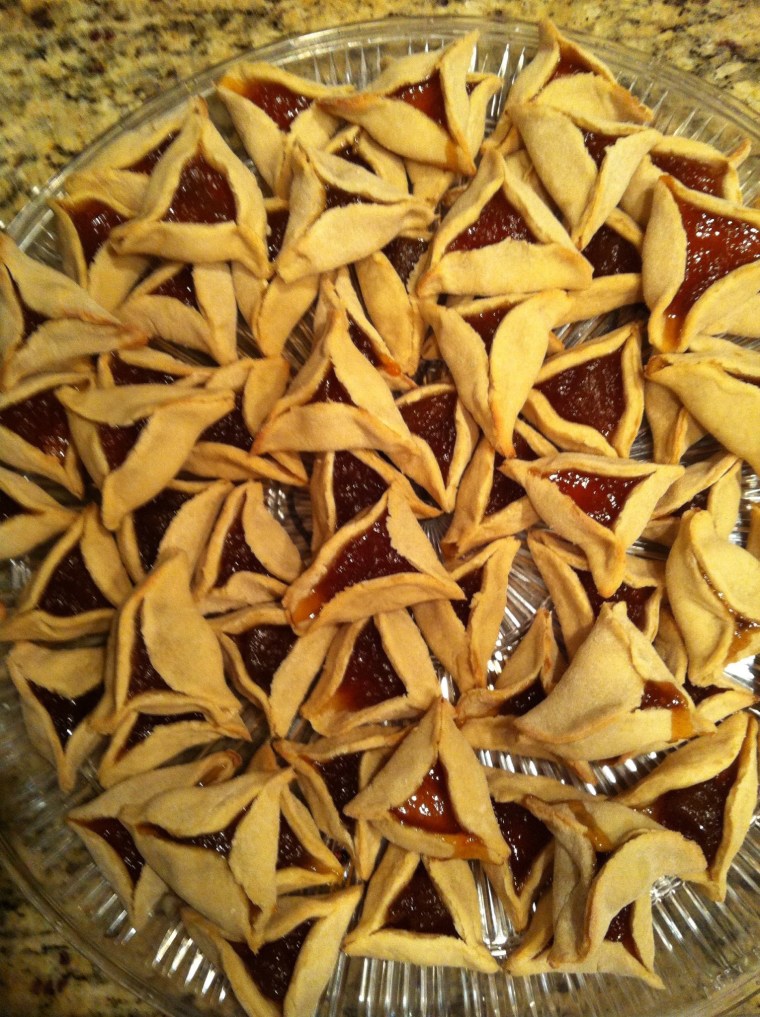
Purim Hamentaschen (D)

Traditional fillings are poppy seed and prune, but apricot preserves, apple butter, pineapple preserves, and cherry pie filling all work quite well.

Ingredients

2/3 Cbutter
½ Cgranulated sugar
1egg
¼ C“no pulp” orange juice
1 Call-purpose flour
1 Cwheat flour

Directions

1Blend butter and sugar thoroughly.  Add egg and blend thoroughly.  Add orange juice and blend thoroughly.
2Add flours, ½ C at a time, alternating white and wheat, blending thoroughly between each.  Refrigerate batter overnight or at least a few hours.
3Roll dough as thin as you can without getting holes in the dough.  Cut out 3″ – 4″ circles.
4Place 1 T selected filling in the middle of each circle.  Fold up the sides to make a triangle, overlapping the sides as much as possible so just a little filling shows through the middle.  Pinch the corners together firmly (dab lightly with water if needed) so they don’t pull apart while baking.
5Bake in 375˚ oven for 10 – 15 minutes, until golden brown but before the filling boils over.